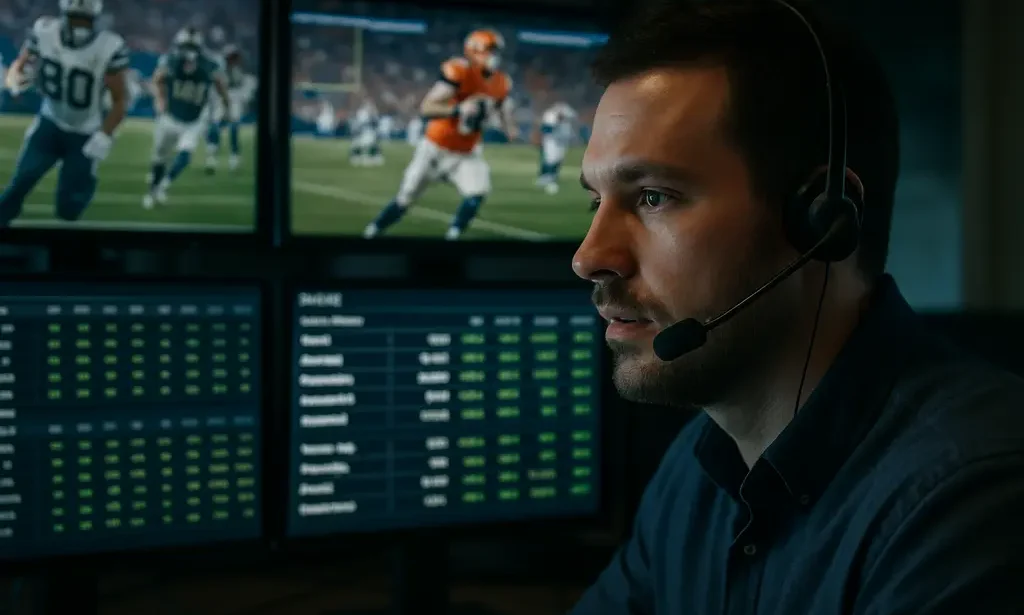
Live prop betting moved through a measurable reset before and during the 2026 NFL season. As of September 30, 2026, the strongest evidence did not point to a simple growth story. Official data access expanded, sportsbook product capacity improved, and bettors continued using props, yet recent behavior data showed live betting share had weakened versus the prior NFL cycle. For market evaluation, that mix matters: better feeds can support faster pricing, but demand, rules, and line availability still determine whether a market is deep enough to compare responsibly.
Live Prop Betting Data Feeds And Operators
Official NFL Data Access
The biggest structural change came from the NFL’s official commercial relationships. On August 27, 2026, the league announced multi-year official data and commercial partnerships with DraftKings, FanDuel, and Fanatics, giving those operators access to real-time play-by-play statistics, proprietary Next Gen Stats, and video betting tools, according to the NFL announcement. The stated purpose was tied to enhancing live prop and micro-bet products, which makes the agreement directly relevant to market depth and update speed.
That does not mean every live market becomes equally efficient. A data feed can reduce latency, but sportsbook risk controls, state rules, player availability, and operator-specific limits still shape what is actually posted. From a performance-metrics angle, the useful question is not whether a feed exists. It is whether comparable markets appear across books, update consistently, and maintain enough limits to be meaningful for analysis.
Genius Sports Distribution Role
The NFL’s data structure also sits on its extended relationship with Genius Sports. In July 2023, the NFL extended that partnership through the 2027-28 season, giving Genius Sports exclusive rights to distribute official league data, including play-by-play and Next Gen Stats, across media and sportsbooks in the United States and Canada, as described by the NFL partnership release. The research notes state that Genius Sports powers over 98% of the legal U.S. sports betting market with those feeds.
For live prop betting analysis, that concentration creates a useful baseline. Many operators may start from similar official inputs, but their trading models can still produce different posted lines, hold levels, suspension behavior, and acceptance rules. That is where market comparison becomes more informative than simply checking whether an operator has official data.
Demand Signals From 2025-26 Behavior
Live Usage Versus Preference
Consumer behavior data in the research notes showed a gap between usage and stated preference. In August 2026, Optimove reported survey data from 926 U.S. adults who bet on the NFL during the 2025-26 season. Among that group, 84% had placed at least one live bet during the season, while only 34% said they preferred live betting. That distinction is important because occasional use can be high even when a product is not the dominant choice.
Pregame point spreads and moneylines remained the dominant bet types in the same research summary. That matters for evaluating live prop betting because a large available menu does not automatically imply primary demand. A user may place one in-game wager while still concentrating most activity in pregame markets, parlays, or bet-builder products.
Share Decline In Live Betting
The research notes also cited a reported decline in live or in-play share during the 2025-26 window, from roughly 37% of total bets to about 25%. The cited reason was movement toward pregame parlays and bet-builder products. Because that source was not among the approved citation set for this article, the figure should be treated as a research-note indicator rather than a fully audited market statistic here.
Still, the direction is worth testing against operator menus. If live share falls while official feed quality improves, analysts should avoid assuming that technical capacity and customer demand move together. A sharper feed can support more precise in-game pricing, but customers may still prefer products with fixed pregame construction or simpler comparison across operators.
Prop Pricing Differences And Market Depth
Line Variation Across Books
A September 6, 2026 study in the research notes compared DraftKings and FanDuel across 3,640 player props from the first half of the 2025 regular season. It found that the two sportsbooks posted different lines on the same prop 48% of the time. The same study reported that selecting the better line for the under improved the under hit rate from 52.4% to 53.2%, with about a one percentage-point return gain.
Those figures fit a market-comparison workflow: record identical player, market, line, price, book, and timestamp; separate line value from price value; then test whether any observed gap survived after accounting for vig and availability. For related work on NFL market depth and in-game prop variety, Bettor Search has also covered NFL live betting market depth.
Receptions Props As A Segment Test
The research notes included a specific receptions-prop sample from the 90 days up to September 29, 2026. In that sample, receptions props cleared the posted over line 31.4% of the time in aggregate, while the lowest line, 0.5 receptions, cleared 86.3% of the time. The same notes said overs became less frequent as lines moved higher, including 4.5 receptions or above.
This is a useful reminder that prop categories should not be evaluated as one block. A 0.5 receptions line behaves differently from a higher-volume receiving line, and aggregate over rates can obscure that split. For live prop betting, the segmentation problem is even sharper because lines move after injuries, drives, game script, and time remaining. A fair review needs line-level buckets rather than a broad “props are high” or “props are low” reading.
| Market Signal | Research Finding | Evaluation Use |
|---|---|---|
| Official operator data deals | DraftKings, FanDuel, and Fanatics received access to real-time NFL data tools on August 27, 2026 | Check whether live menus update faster and remain available |
| Live betting participation | 84% of surveyed NFL bettors placed at least one live bet in 2025-26 | Separate occasional use from stated preference |
| Prop line variation | DraftKings and FanDuel differed on the same prop line 48% of the time in one 2025 sample | Track line, price, timing, and market limits by operator |
| Receptions over rate | 31.4% aggregate over rate in a 90-day sample through September 29, 2026 | Segment by posted line instead of using category averages |
Regulation And Access By State

Prediction Markets And Prop-Style Contracts
The regulatory record in the research notes showed a split by jurisdiction. As of August 2026, a federal judge temporarily blocked Minnesota’s law banning prediction markets before it was set to take effect, with the decision described as clarifying that federal law governed commission-registered prediction markets such as Kalshi and Polymarket. At the same time, Utah was being allowed to enforce state anti-gambling laws against Kalshi, including restrictions on proposition-style sports contracts.
A separate late-August 2026 development in the research notes said the 9th U.S. Circuit Court of Appeals ruled that the federal Commodity Exchange Act did not preempt states from regulating platforms such as Kalshi in sports-betting contexts. Taken together, the notes point to a patchwork access model rather than one national rule for prop-style and live contracts.
Regulated Sportsbooks Versus Offshore Access
For market comparison, regulated access matters as much as price. A prop posted in one state may not be available in another, and prediction-market-style contracts may face different rules than sportsbook wagers. Offshore markets can appear broader, but they lack the same state-level regulatory framework, consumer protections, and dispute pathways referenced in regulated U.S. markets.
Analysts should avoid blending regulated sportsbook data, prediction-market contract data, and offshore pricing into one clean sample unless the access rules are labeled. A clean dataset needs jurisdiction, operator type, timestamp, and market status. For broader betting-market coverage within the same network, a visit to Betting Challengers offers related insights, although each operator and jurisdiction still requires separate verification.
NFL Live Prop Betting Market Checks
Metrics Worth Tracking
A cautious performance review of live prop betting should start with observable metrics rather than claims about future profitability. Useful checks include line availability by quarter, suspension frequency after major plays, difference between posted lines across operators, price movement after official stat updates, and whether a prop remains open long enough for comparison. These checks are especially relevant after the August 27, 2026 operator partnerships because official data access may improve inputs without making every posted market equally usable.
- Record player, stat type, line, price, operator, state, timestamp, and game clock when available.
- Separate pregame props, live props, same-game parlays, and micro-bet markets before calculating rates.
- Compare identical lines first; then review whether price differences offset line differences.
- Flag low-liquidity or briefly suspended markets rather than treating them as standard available prices.
- Review state rules before comparing sportsbook markets with prediction-market-style contracts.
How To Read The 2026 Shift
The 2026 NFL market had two forces moving at the same time. Supply-side infrastructure improved through official data and commercial partnerships, while the research notes showed softer live share and continued migration toward pregame parlays and bet-builder products. That split does not make the live prop category weak or strong by itself. It means evaluation has to be more granular.
The best-supported reading is that live NFL props became more data-dependent and more operator-specific. Official feeds supported faster in-game products, but pricing differences, jurisdictional access, and bettor preference patterns still shaped the actual market. For analysts, the task is to measure what is posted, how long it stays open, and whether line variation remains after normalizing for price and rules. That approach keeps the focus on evidence rather than unsupported assumptions about where the market will go next.